Planning a trip to the world’s largest archipelago is an exciting adventure, but a practical question always comes up during the preparation phase: how should you manage your expenses on the ground? Navigating your money in Indonesia requires some planning to avoid exorbitant bank fees, exchange counter scams, and unexpected technical glitches on remote islands. Whether you are planning a relaxing beach getaway, an adventure trek, or a dream honeymoon, managing your budget in the local currency is essential for a seamless travel experience.
As the country shifts toward digital transactions while remaining heavily reliant on cash in rural areas, the Indonesian economy operates on a mix of modern convenience and traditional habits. To give you total clarity, our expert local travel agency has compiled this up-to-date financial guide for 2026. Follow these insights to master your travel budget and handle your money in Indonesia like a seasoned local.
The Local Currency: Understanding the Indonesian Rupiah (IDR)
The official currency in Indonesia is the Indonesian Rupiah, internationally abbreviated as IDR and locally symbolized as “Rp”. For travelers coming from Western countries, handling the local cash will instantly make you feel like an overnight millionaire. Due to its high nominal value, Indonesian banknotes feature quite a few zeros, ranging from Rp 1,000 all the way up to Rp 100,000. Managing your money in Indonesia means getting used to these bright, colorful bills.
The Indonesian rupiah exchange rate fluctuates daily on the international foreign exchange markets. To track currency movements in real-time, you can always consult the official website of the Central Bank of Indonesia (Bank Indonesia). When calculating your daily expenses on the spot, a handy mental trick is to drop the last three zeros to get a quick baseline conversion, though using a live currency converter app is highly recommended. The most common banknotes you will use when handling money in Indonesia are the Rp 10,000, Rp 20,000, Rp 50,000, and Rp 100,000 bills. It is always wise to keep small change on hand, as local taxi drivers or street food vendors rarely have change for a Rp 100,000 note.
Paying in the Archipelago: Withdrawing Money in Indonesia
When it comes to getting cash, the most straightforward and cost-effective option is to make an Indonesia ATM withdrawal directly at a local machine. ATMs are widely available across major tourist hotspots in Bali, bustling urban centers in Java, and popular beach towns in Lombok. However, if you venture off the beaten path to explore the wildlife of Sumatra or the remote traditional villages of Sulawesi, cash machines become few and far between. Always anticipate your cash needs so you can handle your money in Indonesia smoothly before heading into remote areas.
Choosing the Right ATM
Not all cash machines are created equal when you want to secure your money in Indonesia. To minimize the risk of card skimming, always use ATMs located inside a well-lit, guarded bank branch (such as BCA, Mandiri, BNI, or BRI). Additionally, look closely at the sticker on the machine: it will indicate whether the ATM dispenses Rp 50,000 or Rp 100,000 notes. Machines dispensing Rp 100,000 bills allow you to withdraw larger total sums in a single transaction, which helps reduce cumulative transaction fees for your money in Indonesia.
Crucial ATM Safety Tip: Unlike in many Western countries, an ATM in Bali or elsewhere in Indonesia will dispense your cash first, then print your receipt, and finally eject your debit or credit card. Never walk away immediately after grabbing your cash, or you risk leaving your card behind in the machine!
The Dynamic Currency Conversion (DCC) Trap
When withdrawing your money in Indonesia, the ATM screen will often ask if you wish to be billed in your home currency (USD, EUR, CAD, GBP) or in the local currency (IDR). Always choose to be charged in the local currency (Without Conversion / Local Currency). If you choose your home currency, the local Indonesian bank applies its own heavily marked-up exchange rate, resulting in a hidden loss of up to 10% of your total withdrawal amount.
Using Your Credit Card in Indonesia: Where and How?
Using an international credit card in Indonesia has become standard practice over the last few years. Visa and Mastercard are accepted at almost all high-end hotels, upscale restaurants, dive centers, and trendy boutiques in Seminyak or Ubud. This makes it incredibly easy to manage your budget and secure your money in Indonesia without carrying massive bundles of cash everywhere.
That being said, Indonesia remains fundamentally a cash-based society (Cash is King). For meals at local warungs, purchases at traditional markets, tipping your tour guides, or buying handmade souvenirs in rural villages, paying in Indonesia requires physical banknotes. Furthermore, be aware that many independent local merchants apply a legal 2% to 3% surcharge to cover card processing fees. It is always polite to ask before tapping your card.
To help you decide between cash and card during your journey, refer to this handy comparison table:
| Travel Scenario | Recommended Payment Method | Primary Reason |
|---|---|---|
| Luxury hotels, beach resorts, and private villas | Credit / Debit Card | Secure handling of high amounts, clear tracking of money in Indonesia |
| Local warungs and street food stalls | Cash (Small bills) | No card terminals or digital payment options available |
| Outdoor activities, private local guides | Cash or Local Bank Transfer | Direct payment to local artisans and independent operators |
| Shopping malls in Jakarta or Bali boutiques | Credit / Debit Card | Convenient, secure, and usually no merchant surcharges |
| Local transport, scooter rentals, private drivers | Cash | Immediate on-the-spot payment expected for money in Indonesia |
Bank Fees and Exchange Rates: Smart Budget Optimization
To optimize how you spend your money in Indonesia, you must contact your home bank before your departure date. Let them know your exact travel dates in Southeast Asia so their automated fraud prevention systems do not flag and freeze your card on your first day abroad.
Minimizing Foreign Transaction Fees
Traditional brick-and-mortar banks generally charge two types of commissions when you use your card outside your home country: a flat fee per transaction plus a variable percentage fee on the total amount. These cumulative credit card fees in Indonesia can quietly drain your vacation budget if you rely on them frequently to access your money in Indonesia.
To bypass this, the smartest travel strategy in 2026 is to carry a multi-currency card from a digital neobank (such as Revolut, Wise, or N26). These financial services offer international travel accounts featuring zero or minimal foreign transaction fees and apply the real mid-market exchange rate without hidden margins, keeping your money in Indonesia right where it belongs: in your pocket.
Should You Bring Foreign Cash to Exchange?
Yes, keeping a backup supply of physical foreign currency (such as US Dollars, Euros, or Australian Dollars) is an excellent safety measure. If an ATM goes offline or your card gets blocked, an authorized money changer can save the day. To secure the fairest Indonesian rupiah exchange rate, avoid airport currency booths at all costs, as they offer notoriously poor rates. In town, look exclusively for official, authorized money changers displaying a prominent green shield logo (“Authorized Money Changer”). Steer clear of small, informal kiosks in back alleys displaying unrealistically high rates; these are almost always front operations designed to shortchange you through sleight-of-hand counting tricks when changing your money in Indonesia.
FAQ: Essential Money Tips for Traveling in Indonesia
What is the best bank card for managing money in Indonesia?
Travel credit or debit cards from online neobanks are by far the best choices. They allow you to avoid or significantly reduce the high foreign exchange transaction fees and ATM withdrawal commissions charged by traditional banks.
Can I use mobile payment apps like Apple Pay or Google Pay?
Contactless mobile payments are growing rapidly in major supermarkets, modern cafes, and boutique hotels across Bali and Jakarta. However, this technology is far from universal. You cannot rely solely on your smartphone to manage your money in Indonesia when island-hopping.
What is the maximum amount I can withdraw from an Indonesian ATM?
The withdrawal limit per single transaction typically ranges from Rp 1,250,000 to Rp 3,000,000 (roughly $80 to $200 USD) depending on the specific bank and whether the machine holds Rp 50,000 or Rp 100,000 bills. However, you can insert your card again and make multiple consecutive withdrawals as long as your home bank’s daily limit allows it.
Is tipping customary when spending money in Indonesia?
Tipping is not mandatory in Indonesian culture, but it is highly appreciated as a gesture of kindness. In westernized restaurants and tourist hubs, a 5% to 10% service charge is often automatically added to your final bill. For private drivers and local guides accompanying you on a custom tour, a personal tip is a wonderful way to reward great service.
What should I do if a local ATM swallows my credit card?
If this happens during business hours at an ATM physically attached to a bank branch, walk straight inside with your passport to ask for assistance. If the machine is isolated or unbranded, open your mobile banking app immediately to lock or freeze your card to prevent unauthorized use of your money in Indonesia.
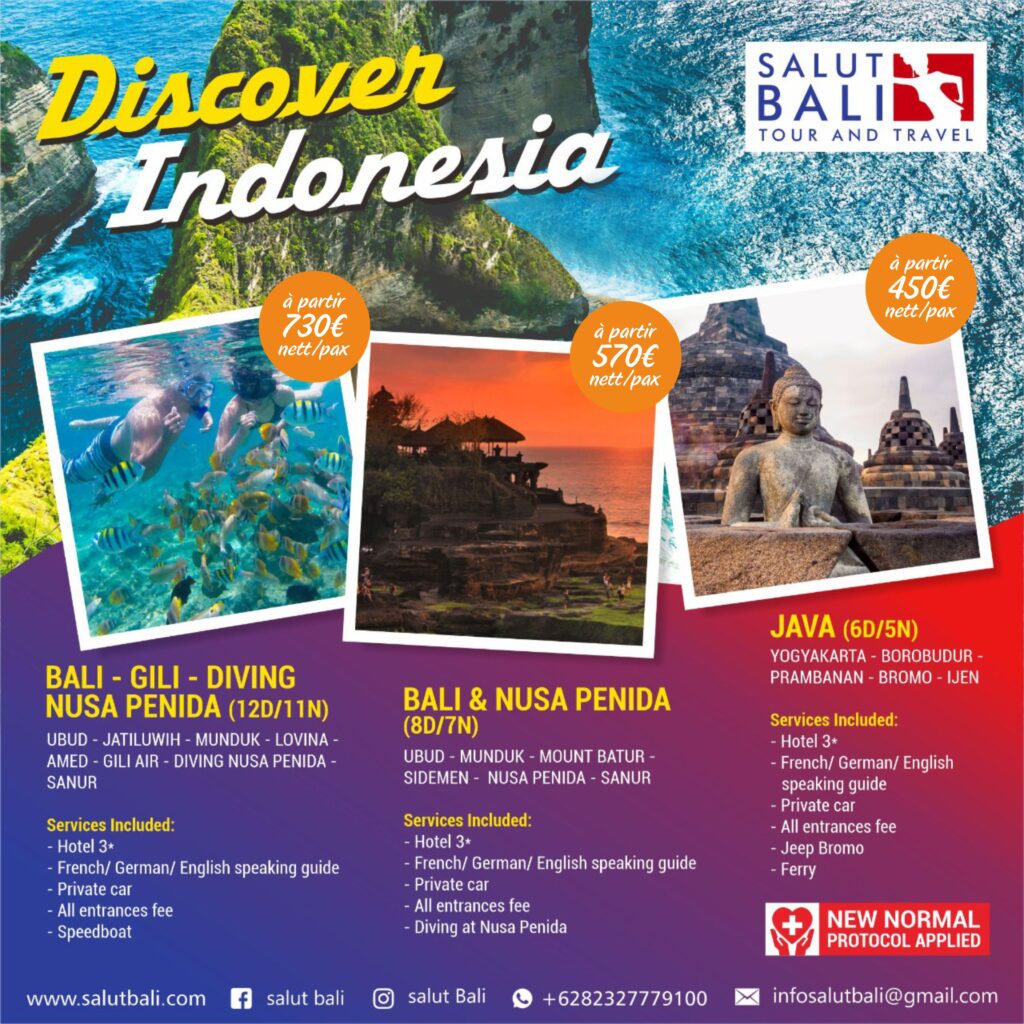
Design a Stress-Free Custom Journey with Salut Bali
Calculating exchange rates, estimating tips, and carrying bundles of physical cash can sometimes feel overwhelming when planning a vacation across an exotic archipelago. That is exactly where booking through a trusted local travel agency makes a world of difference.
By co-creating your custom itinerary with our dedicated team, all your core trip essentials—including handpicked boutique hotels, private AC vehicles with dedicated drivers, and domestic flights to discover the majestic Komodo National Park or the white-sand beaches of Lombok and Gili—are safely settled and paid for in advance. Once you land, you can forget about the complex math conversions and focus entirely on immersing yourself in the rich local culture without stressing over your daily money in Indonesia.
Contactez Salut Bali dès aujourd’hui pour créer votre voyage sur mesure en Indonésie avec une agence locale francophone expérimentée.